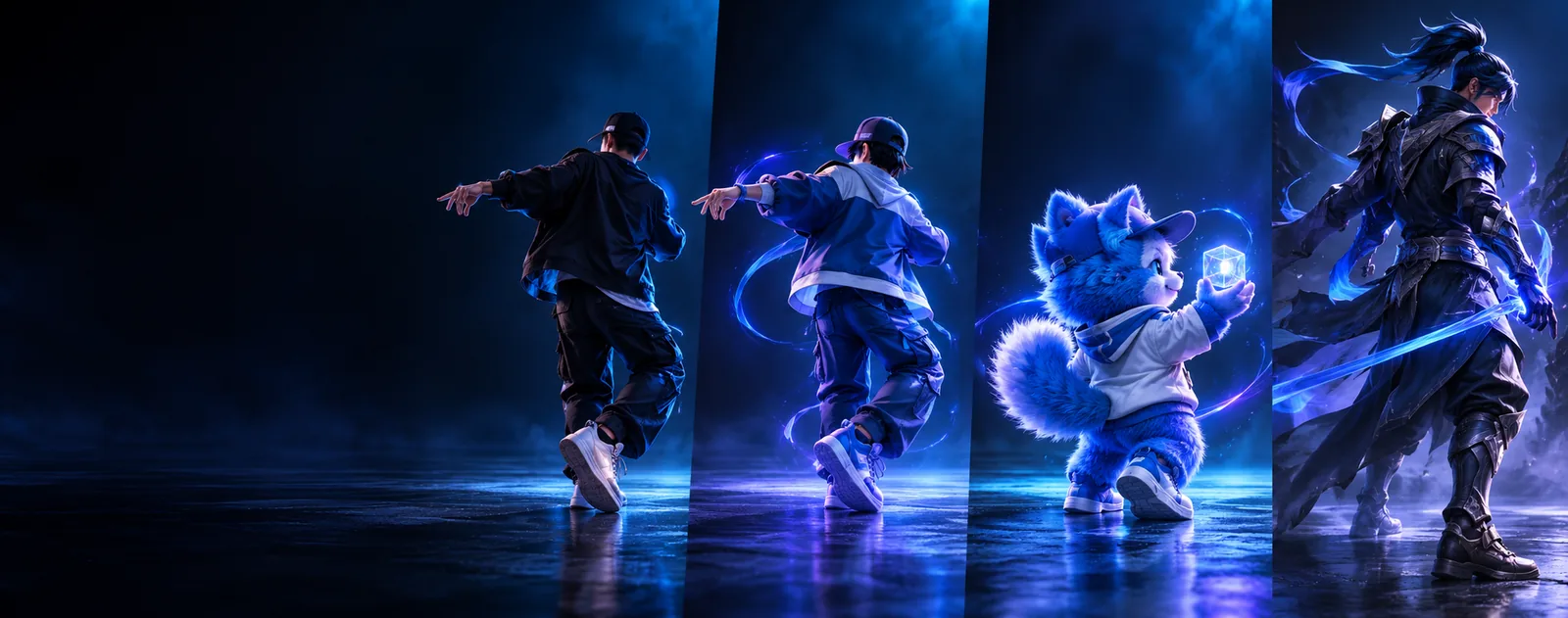
Motion Control

Reference-led video

Explore ai motion mimic free with a clear movement brief

Motion mimicry uses a reference performance to guide movement in a new clip. Describe the action and the subject you want to depict, then check which inputs and access terms the destination actually supports.

Check available inputs at the destination
Motion Control video creation imagery

A/B structural difference table

A source performance and a generated result may show the same action without preserving the same timing or body mechanics. Compare observable features rather than judging resemblance alone.

Movement reference
Generated clip

Subject

Movement reference

The recorded performer

Generated clip

The depicted subject may differ

Action order

Movement reference

Fixed by the recording

Generated clip

Should be checked against the recording

Timing

Movement reference

Visible in the source frames

Generated clip

May speed up, slow down, or drift

Body position

Movement reference

Observable at each moment

Generated clip

May change with framing or generation

Contact with objects

Movement reference

Visible where the source shows it

Generated clip

Needs separate inspection for missed contact

Camera movement

Movement reference

Part of the recorded reference

Generated clip

Can complicate comparison if it changes

What conversion loses

A convincing pose is not proof of a faithful performance. Small losses often appear between key poses, especially during turns, hand contact, and changes of direction.

Dance editor

A step lands on the right pose but misses the beat. Compare footfalls and pauses against the source before keeping the take.

For a workflow centered on matching the rhythm of two clips, ai motion sync free explains the synchronization question.

ai motion sync free

Character animator

The subject crosses its arms, but the hands pass through the body. Review the crossing frame by frame, not just the final pose.

When you already have footage to transform, video to video ai covers that input-to-output route.

video to video ai

Social video maker

A wave looks natural until the face and hands move at different speeds. Keep the shot short enough to inspect each gesture.

If the starting point is a still portrait instead of a performance clip, image to video ai addresses that different source.

image to video ai

The tool block

Today's reference-led video workflows build on older ways of studying and transferring motion. This history helps distinguish observing movement from accurately reproducing it.

  1. Movement broken into frames

    Eadweard Muybridge's sequential photographs made individual phases of a moving subject easier to examine.

  2. Rotoscoping patented

    Tracing filmed performance offered animators a way to carry observed movement into a different visual form.

  3. Digital motion capture expands

    Recorded performer movement increasingly drove digital characters, while cleanup remained important for convincing results.

  4. Generative video adds new choices

    Reference-guided workflows can depict movement in newly generated imagery. Their available inputs and degree of fidelity depend on the particular tool.

How to verify after

Check the action, not just the first frame

Before using a generated clip, compare it with the reference from start to finish. If you are researching ai motion mimic free access, confirm the current input requirements and terms at the destination; this page does not establish that generation is free.

Explore video tools
  • Watch for the same sequence of gestures and pauses.
  • Inspect hands, feet, and object contact at normal speed and frame by frame.
  • Check whether camera changes hide a missed movement.

Variant FAQ

That depends on the tool and its current access terms. Check the destination for any limits, required account, or payment before preparing a reference clip.

A short movement description makes the intended action clear. If a tool accepts reference footage, choose a clip where the subject stays visible and the gesture has a distinct beginning and end; verify supported inputs first.

Do not assume it does. Compare action order, timing, limb placement, and contact with objects throughout the result, particularly between prominent poses.

Mimicry concerns whether a depicted subject follows a reference action. Synchronization focuses on whether movements align in time, such as matching gestures or steps to another clip or beat.

Start creating
Start creating